Delhi Tourism.Com
____
 
 Tourist Destination Hotels /Accomodation  Travel Packages  Travel Information  Weather Chart


AJMER


Information


Sightseeing


Hotels


Travel Info


Tour Package


Helpdesk


AJMER SIGHTSEEING

 
TARAGARH FORT
 

The Taragarh Fort was built on a hilltop by Ajaipal Chauhan, the founder of the city in the 7th century and is about 3 km from the city of Ajmer. A steep climb up rewards the weary visitor with an amazing birds eye view of Ajmer. The first hill fort of India was built in 1100 by Ajayapal Chauhan. The fort gives excellent views of the town below and also known as the Star Fort. It has a thickness of four and a half meters and a winding uphill path leads to this rectangular fort. Most of the fort is now in ruins though at the time of its construction, it was supposed to be the invincible fort and so named as Ajai Meru (invincible fort).


ADHAI DIN KA JHONPARA

Adhai-din-ka-Jhonpra (two-and-a-half-day shelter) is considered as the first important Islamic structure to be built in India. According to the legends, Arhai-din-ka-Jhonpra was a Sanskrit College initially and Mohammed Ghori converted the college into a mosque within two and a half days, hence the name. According to another legend, the structure is named after a festival, which carried on for two and a half days. The monument has seven arched walls with Islamic calligraphy, though most of it now remains in ruins.


DARGAH OF GARIB NAWAZ - KHWAJA MOIN-UD-DIN CHISHTI

Ajmer is venerated as a holy place for both Hindus and Muslims. It has the mausoleum of the Sufi saint, Khwaja Moinuddin Chisti whose blessings are eagerly sought by pilgrims to his dargah. Known as the ‘Dargah Sharif’ the last resting place of the saint who died in 1235 lies at the foot of a barren hill. It is said that Mughal Emperor Humayun built the shrine and the Buland Darwaza, carved in silver, was built by the Nizam of ajmer. The tomb of Khwaja is surrounded by a silver railing and there is a separate women's praying room, said to be built by Chimni Begum - the daughter of Shahjahan.  The tomb attracts hundreds of thousands of pilgrims every year on the anniversary of the saint's death.


MAYO COLLEGE

Still counted as one of the finest public schools in India, Mayo College was built in AD 1873. The aim of the school was to provide liberal education to the young Indian princes and wards of the colonial rulers. Today, school is open for anyone who can pay the steep fee and take admissions.


ANA SAGAR LAKE

This lake was built by Anaji during 1135-1150 AD. Later the mughal emperors made additional constructions to beautify the lake. The 'Baradari', a marble pavilion was built by Shah Jahan and the ' Daulat Bagh ' gardens were laid by Jahangir. This lake is located towards the north of Ajmer city.


NASIYAN (JAIN TEMPLE)

The Red temple on Prithviraj Marg is a Jain temple built last century and is definitely worth checking out. Its double storey hall contains a fascinating series of large, gilt wooden figures from Jain mythology which depict the Jain concept of the ancient world. This red coloured Jain temple was built in the late 19th century. The wooden gilt in the double storeyed hall depicts scenes from the Jain mythology. The beauty of this temple is widely acclaimed.


PUSHKAR LAKE

The lake, situated on the edge of the desert and surrounded by hills on the three sides, is separated from Ajmer by 'Nag Pahar'- the snake mountain. On this mountain the Panchkund and the cave of saint Agastya are located. It is believed that Kalidasa - the 4th century Sanskrit poet and play right, chose the setting for his masterpiece 'Abhigyana Shakuntalam 'in this forest heritage. According to legend, the origin of Pushkar dates back to the time when Lord Brahma was on his way in search of a tranquil land to perform a 'Yagna'. A lotus fell form the hand of the Lord into this valley. A lake sprang up on this spot and was dedicated to him. A Brahma temple located here is a popular place of pilgrimage.


PUSHKAR FAIR

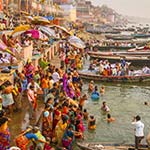
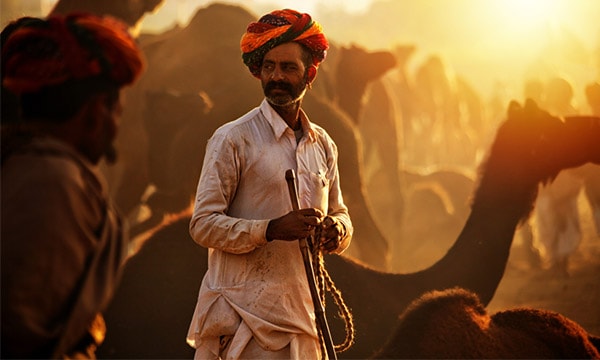
Easily the most easily identifiable of Rajasthan's many fairs, Pushkar has come to symbolize the febrile heartbeat of the people of the state. Held in November in Pushkar, the temple town close to Ajmer, where an 8th century temple of Brahma draws the faithful, it is located on the banks of a lake. Pilgrims bathe at the ghats and pray at the temple, while the actual fair is held in the vast stretching desert around it. Here, traders set camp to strike deals at India's, and probably the world's largest camel fair, though hors3es are also sold. It is also a time for friends and families to get together, camp in the desert, entertain each other with folk songs and dances, cook meals over camp fires, and wander through the exuberant melee of people looking for handicrafts, or merely to stand in a queue for the giant wheel... Special tented camps are set up on the occasion for visitors but such is the draw of this fair internationally, that even these are soon exhausted, and people may have to stay in nearby Ajmer, or even as far as Jaipur, visiting here by day.


MAN MAHAL

Along the banks of the Pushkar Lake is the former residence of Raja Man Singh of Amer, Man Mahal. Presently it is converted to RTDC Sarovar Tourist Bungalow ensuring convenient accommodation to travelers. Pushkar Palace (Kishagarh House) adjoining it is a heritage hotel.


FOY SAGAR

Situated at a distance of five km from Ajmer, it was engineered by an Englishman, Mr. Foy. It is an artificial lake built as a famine relief project.


BEAWAR

Located at a distance from 54 km from Ajmer. Here on the day following Holi, a Badshahi procession is taken out, and people throw gulal (coloured powder) on each other.


KISHANGARH

Kishangarh was a princely state ruled by the Rathores and located on National Highway 8. Apart from its fort, the Kishangarh is known for the miniature paintings style known as Kishangarh Art. Phool Mahal (Flower Palace), now converted into a hotel is the main attraction inside the fort. Kishangarh is also known its rich storehouse of marbles.


Tourism in India

India City Guide

Hotels in India

- Delhi Tourism
- Kerala Tourism
- Rajasthan Tourism
- Goa Tourism
- Uttar Pradesh Tourism
- Himachal Tourism
- Tamil Nadu Tourism
- Karnataka Tourism

more...

- Agra Travel
-
Bangalore Travel
- Bikaner Travel
- Chennai Travel
- Cochin Travel
- Delhi Travel
- Hyderabad Travel
- Goa Travel
-
Jaipur Travel
- Jaisalmer Travel
- Jodhpur Travel
-
Khajuraho Travel
- Kolkata Travel
- Mumbai Travel
- Pushkar Travel
- Udaipur Travel
- Varanasi Travel
more...
- Agra Hotels
-
Bangalore Hotels
- Bikaner Hotels
- Chennai Hotels
- Cochin Hotels
- Delhi Hotels
- Hyderabad Hotels
- Goa Hotels
-
Jaipur Hotels
- Jaisalmer Hotels
- Jodhpur Hotels
-
Khajuraho Hotels
- Kolkata Hotels
- Mumbai Hotels
- Pushkar Hotels
- Udaipur Hotels
- Varanasi Hotels
more...
 
 India Travel Packages

Cultural  & Classical  Tour

Package By Motor Coach

Golden Triangle Tour
North India Tour
North India and Nepal Tour
South and West India Tour
                                                               More
Delhi Agra Jaipur  Tour
Rajasthan Tour
                             
More
                                                             
India Tour Packages By Rail India Mini City Tour Packages
North India Tour By Rail
South India Tour By Rail
North and Central  India Tour By Rail
South and West India Tour By Rail
                                                               More
Mumbai City Tour
Delhi City Tour
Chennai City Tour
Bangalore City Tour
                                                               More
India Luxury  Train Tour  By Palace on wheels India Business Tour Packages


Our Other websites - www.newdelhi-hotels.us & www.india-deluxehotels.com www.agra-hotels-india.com, www.bombay-hotels-india.com, www.jaipur-hotels-india.com, www.calcutta-hotels-india.com


    Cancellation | Payment Details | Publisher
All rights Reserved. Best Viewed at 800 x 600 using Netscape or Internet Explorer version 5.0 or above.